
Funded by the Strategic Research Council’s WAWE programme, the multidisciplinary WATERWAYS project examines the use of Baltic Sea maritime routes through the lens of the UN Sustainable Development Goals, developing research-based tools for up-to-date situational awareness, risk assessment and management, and cross-sectoral co-creation of sustainable future pathways.
In this blog post, our postdoc researcher Mahsa Khorasani discusses the use of process mining and NLP to analyze ship behavior in ice and reconstruct the causal chains behind maritime accidents. Learn how our WATERWAYS research connects real-time operational data with the UN Sustainable Development Goals to improve the resilience of global trade.
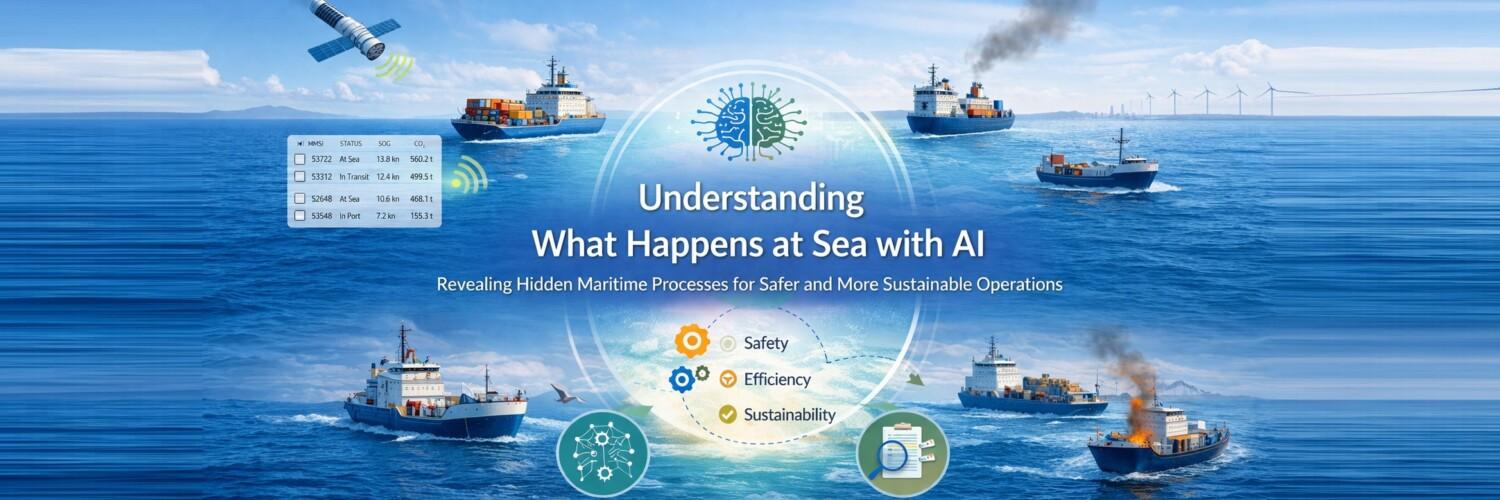
Understanding What Happens at Sea with AI
Every day, ships move across the Baltic Sea, transporting goods that support our daily lives. While these movements may appear simple on a map, they are part of a much more complex system shaped by environmental conditions, operational decisions, and human actions.
Understanding this complexity is not always straightforward. Many important processes remain hidden beneath the surface.
In our project, we explore how data and artificial intelligence (AI) can help reveal these hidden processes and support safer and more sustainable maritime operations.
Looking Beyond Ship Movements in Ice-Covered Waters
Ships continuously transmit signals through the Automatic Identification System (AIS), providing information about their position, speed, and direction. This data allows us to track vessels in real time and observe their movements across the sea.
However, tracking movement alone does not explain what is actually happening in maritime operations.
For instance:
- Why does a ship slow down or change direction?
- When does it require assistance from an icebreaker?
- How do delays and waiting times develop?
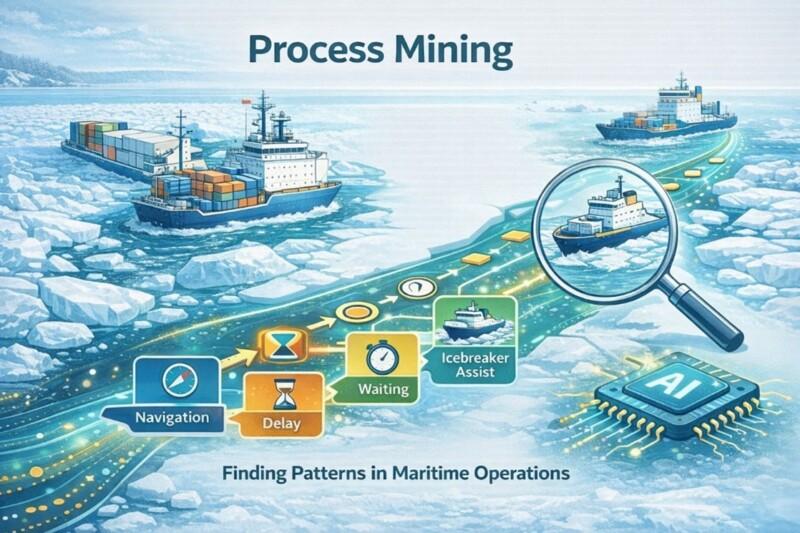
To answer these questions, we use process mining, a data-driven approach that reconstructs real operational processes from historical data. Instead of focusing on individual data points, this approach allows us to understand the sequence of activities that take place over time.
This is especially important in winter navigation. The Baltic Sea is one of the few regions where ships regularly operate in ice-covered conditions. During winter, navigation becomes more complex, and ships often depend on icebreakers for safe movement.
Ice conditions can significantly slow down vessels, increase fuel consumption, and create safety risks. Ships may need to wait for assistance, form convoys, or adjust their routes based on changing ice and weather conditions. These operational patterns are not always visible from raw data, but they have a strong impact on efficiency and sustainability. By analysing AIS data together with contextual information, we can better understand how these processes unfold in reality. This helps us identify inefficiencies, delays, and decision points that shape maritime operations in challenging environments.
Learning from Maritime Accidents
In addition to operational data, accident reports provide another important source of knowledge about maritime systems.
These reports describe incidents in detail, often explaining how a sequence of events leads to an accident. However, they are written as long, unstructured texts, which makes systematic analysis difficult.
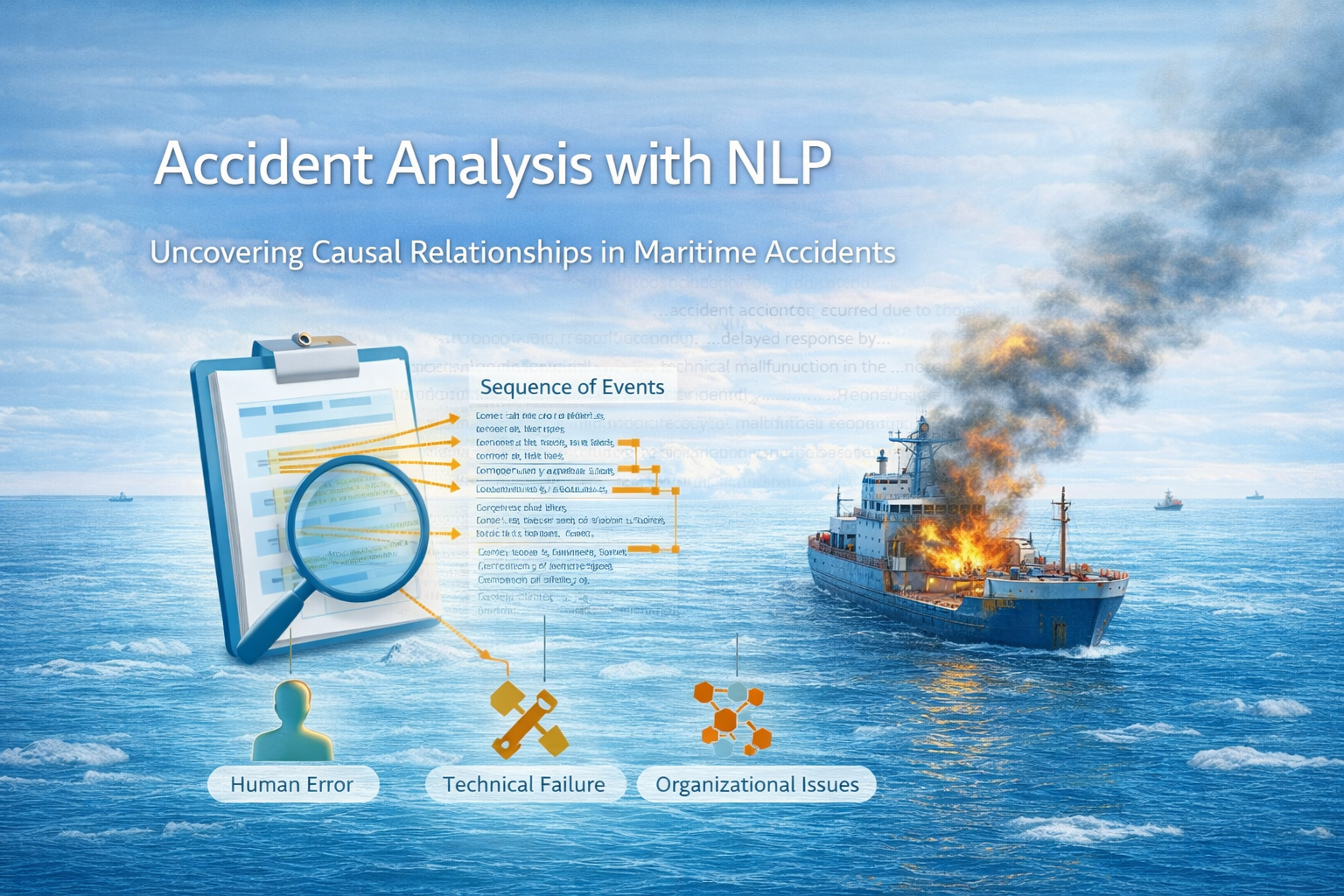
To address this challenge, we use natural language processing (NLP) techniques to analyse accident reports.
With this approach, we can:
- identify causal relationships between events
- reconstruct chains of causes that lead to accidents
- distinguish between different types of causes, such as human error, technical failure, or organisational issues
This is important because accidents are rarely caused by a single factor. Instead, they emerge from a combination of interconnected causes that develop over time.
By transforming narrative reports into structured representations, we can better understand these causal chains. This not only helps us analyse past accidents, but also supports efforts to prevent similar incidents in the future.
Towards Safer and More Sustainable Maritime Systems
Maritime transport plays a central role in global trade, but it is also closely linked to environmental and social challenges. Operational inefficiencies, delays, and accidents can affect fuel consumption, emissions, and human safety.
For example, waiting times in ice conditions can increase energy use, while accidents can lead to pollution and long-term environmental damage. These impacts show that maritime operations are directly connected to broader sustainability concerns.
In our research, we connect operational insights and accident analysis to the United Nations Sustainable Development Goals (SDGs). This allows us to understand how everyday maritime activities relate to global objectives such as safety, environmental protection, and responsible operations.
The aim of this work is not to replace human expertise, but to support it. By combining AI with maritime knowledge, we can reveal hidden patterns, improve understanding of complex systems, and provide insights that support better decision-making.
Looking ahead, these approaches can contribute to the development of maritime systems that are not only more efficient, but also safer and more sustainable. By making complex processes more visible and understandable, we can support the transition toward more responsible and resilient maritime operations.

Mahsa Khorasani
Postdoctoral Researcher
Aalto University
References
- Khorasani, M. et al. (2025). Using Process Modeling Approach and Qualitative Data to Build a Unified Understanding of Icebreaker Operations. ESREL.
- Khorasani, M., Musharraf, M. (2025). Data-Driven Insights into Multi-sectoral Waterway Utilization in the Baltic Sea. BSSC.
- Van der Aalst, W. (2016). Process Mining: Data Science in Action. Springer.
- Graves, N. et al. (2023). ReThink Your Processes! A Review of Process Mining for Sustainability. In Proceedings of the International Conference on ICT for Sustainability (ICT4S 2023).
- Joas, A. et al. (2024). Towards Leveraging Process Mining for Sustainability – An Analysis of Challenges and Potential Solutions. In Business Process Management (BPM 2024), Lecture Notes in Business Information Processing (Vol. 526). Springer.
- Cardenas, I. C., Kozine, I., Taylor, R., & Fenn, A. (2025). Accident analysis reinforced by natural language processing: the case of interactions between maritime and diving operations. Journal of Marine Engineering and Technology.
- Huang, Y., Yan, R., & Zhang, Z. (2026). Automated knowledge extraction from marine accident reports using large language models: Graph construction and evaluation. Ocean & Coastal Management, 272, 108015.
- Images are generated by AI.