

Geopolitical tensions are reshaping oil and chemical spill risks in the Baltic Sea – yet not alone
Geopolitical tensions have become an important factor shaping the Baltic Sea risk environment. However, they do not act in isolation. Their implications for oil and chemical spill risks emerge through interactions with broader environmental, technological and societal changes, affecting both the likelihood of accidents and the capacity to prevent and respond to them. Understanding these interconnected dynamics is therefore essential for strengthening environmental resilience in a rapidly changing world.
Recently, I had the opportunity to speak at the WAWE programme event Environmental Resilience and Preparedness in the Baltic Sea’s Changing Geopolitical Landscape. The seminar – organized as a joint effort of WATERWAYS and its sister project CoWup – brought together policymakers, authorities, practitioners, and researchers from Baltic Sea countries in Helsinki to discuss how we could better anticipate environmental risks, strengthen monitoring and preparedness, and cooperate across borders.
In my talk, I was requested to elaborate how intensifying geopolitical tensions influence shipping-related oil and chemical spill risks in the Baltic Sea. Yet, as often happens with complex problems, the deeper you try to look, the harder it becomes to separate one issue from another.
When discussing marine pollution risks, public attention often focuses on visible events: a tanker grounding, a collision at sea, or an oil slick washing ashore. These events remain important. Shipping accidents and operational failures can release larger or smaller quantities of oil or hazardous chemicals into the marine environment (Fig. 1), and consequences of them all can be severe.
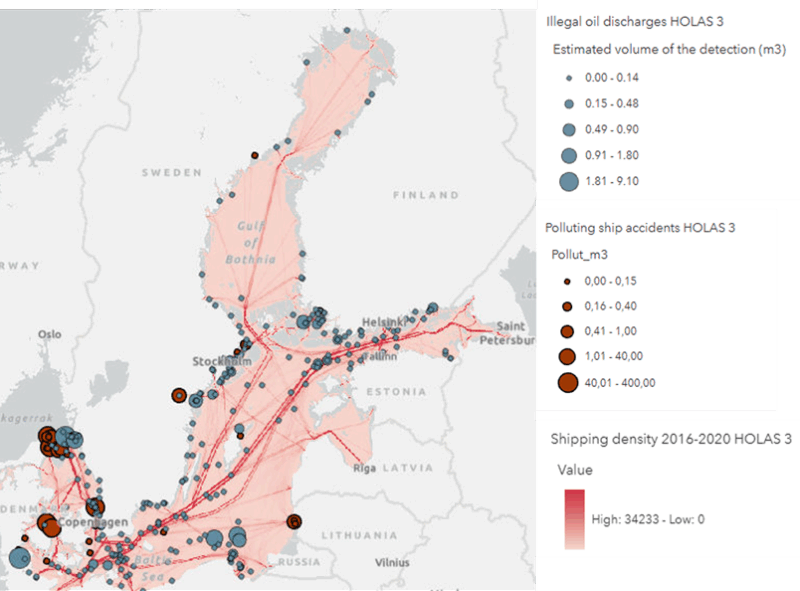
Figure 1. Most detected oil spills are not caused by ship accidents (brown dots), but they are typically smaller releases associated with operational failures or routine maritime activities (blue dots). Source of the presented data: HELCOM HOLAS 3 (years 2016 – 2021). The map is created in and printed from HELCOM Map and Data Service.
As a matter of fact, hazards are manifestations of risk, with complex systemic forces influencing both their causes and consequences.
Today, the maritime operating environment in Baltic Sea is undergoing rapid change. Geopolitical tensions have intensified. Climate change is altering environmental conditions and ice regimes. Maritime transport is adapting to the green transition, introducing new fuels, cargoes, and offshore infrastructure. At the same time, digitalisation and automation are transforming navigation and all maritime operations – even the spill response activities. Together, these developments are reshaping the conditions under which oil and hazardous chemical spill risks emerge [1]. (Fig. 2)
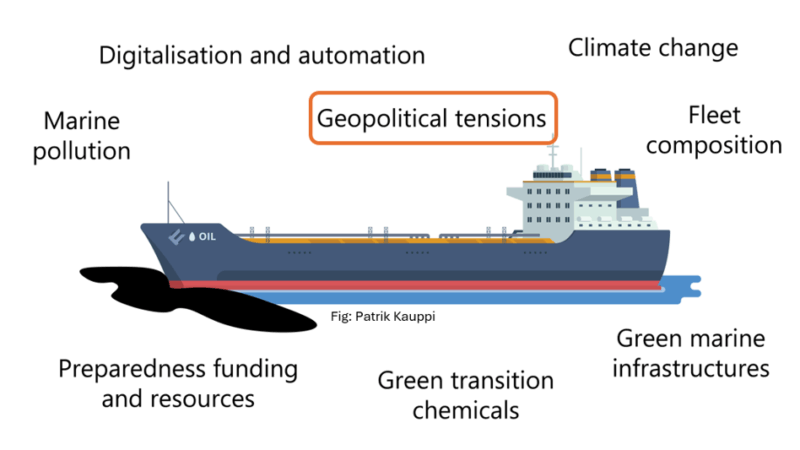
Figure 2. Maritime operational environment in the Baltic Sea is under a rapid multi-dimensional change. Many drivers affect oil and chemical spill risks through complex interlinked pathways [1]. Intensified geopolitical tensions are one piece of this wider systemic change of risk landscape.
Geopolitics affects environmental risk through multiple pathways
The most obvious connection between geopolitics and environmental spill risk is maritime safety.
The emergence of the so-called shadow fleet, vessels operating with limited transparency and sometimes outside established monitoring practices, has attracted growing attention in recent years. Concerns have been raised about vessel condition, insurance coverage, crew competence, and compliance with safety standards. At the same time, increasing military activity, hybrid operations, and disruptions affecting positioning and communication systems create new challenges for safe navigation.
Each of these factors may influence the probability of shipping accidents. In addition, poor crashworthiness of shadow fleet tankers increases the probability of hazardous spills in case of collisions and groundings.
Geopolitical developments may also influence preparedness and response. Regional cooperation has long been one of the cornerstones of oil spill response in the Baltic Sea. As political relationships change, so do the structures through which countries share information, coordinate preparedness, and conduct joint response activities.
In other words, geopolitics can influence both the likelihood of an accident and our capacity to respond when one occurs.
Environmental consequences depend on the state of the marine ecosystem
The consequences of a spill are often discussed as if they depend solely on the amount of oil or chemicals released. However, reality is more complicated.
The severity of environmental impacts depends heavily on where a spill occurs, how the spilled substance behaves in the marine environment, how rapidly response measures can be launched, how effective they are for the substance, and what the prevailing environmental and ecological conditions are.
This is particularly important in the Baltic Sea, where marine ecosystems are already under pressure from eutrophication, hazardous substances, habitat degradation, and other cumulative stressors. Climate change adds further pressure. A stressed ecosystem is generally less capable of tolerating disturbances and recovering from them. In resilience terminology, its capacity to withstand shocks – like exposure to environmentally hazardous spills – is reduced.
This means that the same spill may produce very different consequences depending on the broader environmental context in which it occurs.
Technology creates opportunities and vulnerabilities
At the same time, technological development is changing risk management. Digitalisation, automation, and advanced situational awareness systems offer significant opportunities to improve navigation safety and support spill response operations. Better information, sensing technologies, and decision-support tools can help prevent accidents and improve operational effectiveness.
However, technological dependence also introduces new vulnerabilities. Many modern maritime systems depend on reliable communications and positioning services. Recent years have demonstrated that these systems can be disrupted. As a result, some technologies that enhance safety under normal conditions may become sources of vulnerability under abnormal conditions.
Solutions rarely affect only one part of the system and for that reason their sustainability needs to be evaluated across sectoral borders [2].
Understanding interactions is becoming increasingly important
The complex interactions among the drivers of change described above challenge socio-environmental adaptation and resilience-building.
Each driver in figure 2 simultaneously influences one or more elements of the following spill risk pathway (Fig. 3):
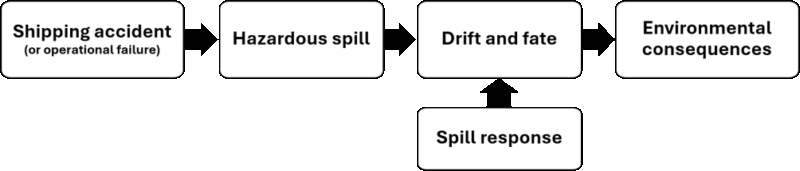
Figure 3. A causal risk generation pathway illustrating how maritime oil and chemical spills materialize. Structuring environmental risks as cause-and-effect chains helps us understand how undesirable events emerge, what consequences they may have, and how risks can be managed through different intervention and mitigation measures.
A change in one part of the system can trigger cascading effects through multiple pathways, influencing accident probabilities, response effectiveness, and ultimately environmental consequences.
As the number of interactions grows, it becomes increasingly challenging to understand the system through human intuition alone. This is one reason why the WATERWAYS project is applying systems analytical approaches and AI tools to study maritime risks and their drivers. Such approaches make it possible to systematically explore indirect effects, identify critical dependencies, and locate potential leverage points where interventions may generate broader benefits across the system.
The goal is not to predict the future, acknowledging the future is highly uncertain. Rather, it is to improve our understanding of how different drivers interact and how resilience can be strengthened under multiple plausible futures.
Building resilience in an uncertain future
As said, maritime spill risks do emerge through complex and interconnected pathways. For this reason, a systems perspective is equally important for building resilience.
In my presentation, I suggested several strategic priorities (Fig. 4) that contribute to resilience-building at different stages of the risk pathway (Fig. 3).
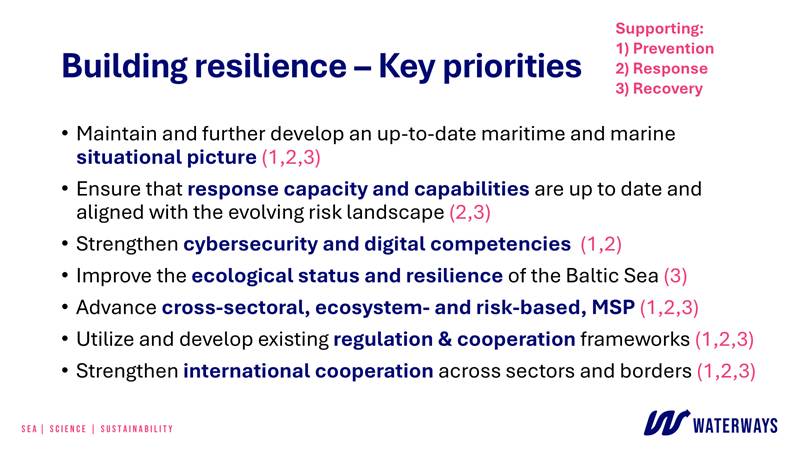
Figure 4. Examples of broader strategic priorities for strengthening overall resilience, supporting different elements of the risk chain.
These priorities are valuable not only because they help manage spill risks. Many also support broader societal goals, including security of supply, maritime security, ecosystem health, governance capacity, and adaptation to future uncertainties. Their value lies in the fact that they strengthen resilience through multiple pathways simultaneously.
From managing individual threats to holistic cross-sectoral resilience strategies
The Baltic Sea risk landscape is changing. Intensified geopolitical tensions are undoubtedly an important driver shaping environmental risks in the region. However, they do not act alone but interact with other drivers such as changing climate and technology, green transition, and the status of the marine ecosystem.
This means that resilience cannot be built effectively by addressing one threat at a time. Instead, we need strategies that target key leverage points across the system, reducing risks through multiple pathways, while generating broader benefits across sectors and policy domains. [3]
This text is based on the presentation “Geopolitical Tensions Shape Oil and Chemical Spill Risks in the Baltic Sea”, presented by the author at the WAWE seminar “Environmental Resilience and Preparedness in the Baltic Sea’s Changing Geopolitical Landscape”, held in Helsinki on 26 October 2026.
Annukka Lehikoinen
Research Director, Kotka Maritime Research Centre
Societal Interaction Lead and co-PI, WATERWAYS project
References
[1] Lehikoinen, A., Kauppi, P., and Cano Bernal, J. E. (2026). Oil and chemical spills in the Baltic Sea: situational overview and preparedness in a changing operating environment. In: Halonen, J. & Hanski, L. (eds.) Preparing for oil and chemical spills in the changing operating environment of the Baltic Sea. Results and recommendations of the MARISEC project. Xamk Development 257, pp 15-25. https://www.theseus.fi/handle/10024/911506
[2] GYROSCOPE Consortium (2025). The Green Transition in Maritime Transport – Anticipatory Cooperation and Regulation for Sustainable Future. Policy and Action Recommendations of the GYROSCOPE Project, 12/2025. https://sites.utu.fi/gyroscope/wp-content/uploads/sites/1255/2026/02/Gyroscope-Policy-Brief.pdf
[3] WATERWAYS Consortium (2026). Finland Must Safeguard Baltic Sea Waterways As a Sustainable Source of Wellbeing, Security and Safety. Policy recommendations of the WATERWAYS Project, 10/2026. https://waterways.projectsites.aalto.fi/wp-content/uploads/sites/25/2026/10/Waterways-policy-brief_EN.pdf