
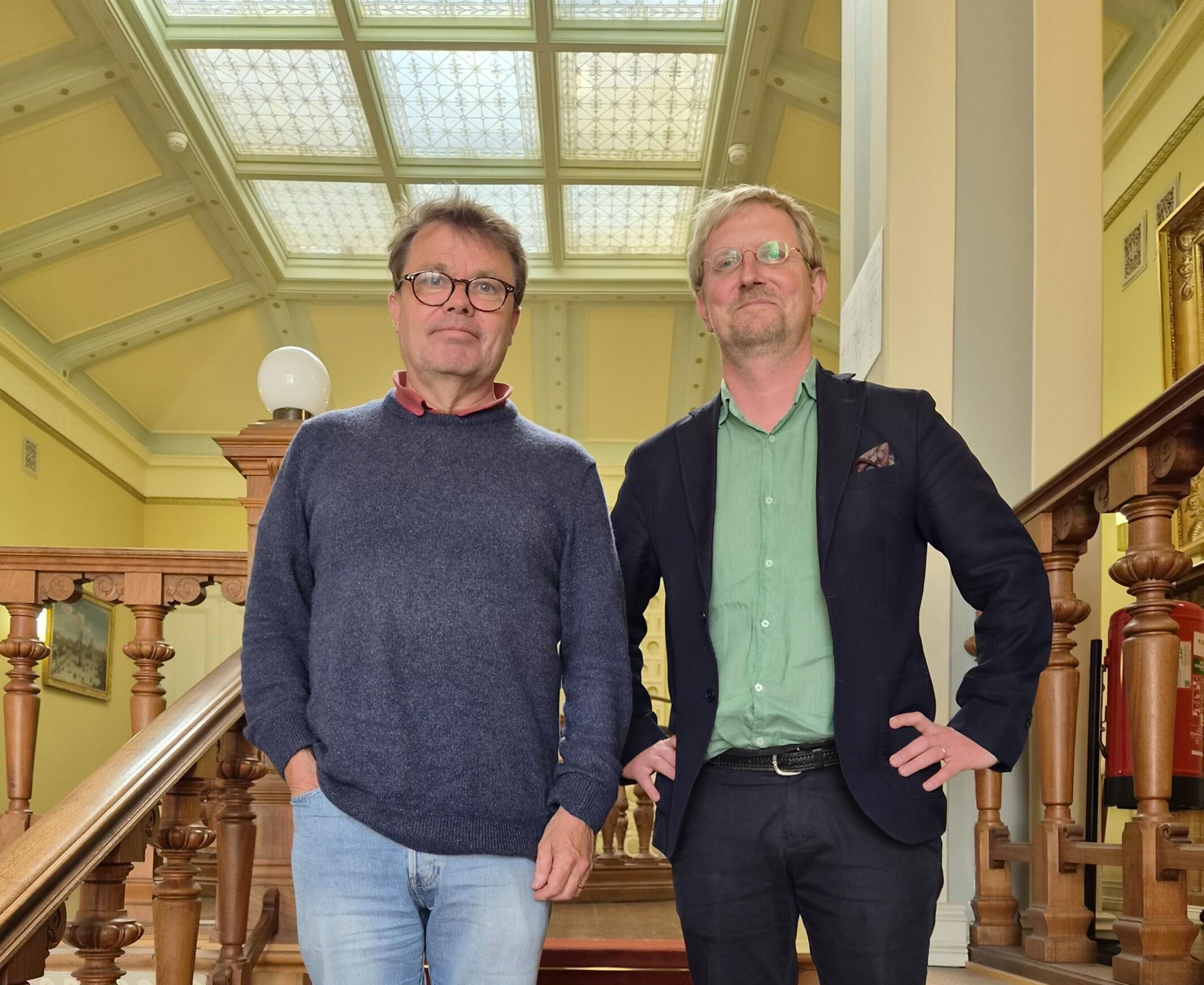
Research Group Spotlight: Åbo Akademi Research group on Maritime and Environmental Law
In each issue of the WATERWAYS newsletter, we introduce one of the research groups contributing to the project. The short interviews aim to highlight the diverse expertise, research interests, and stakeholder collaborations that shape the work within the project.
Principal Investigator: Professor Henrik Ringbom
Organization: School of Law, Åbo Akademi University
1. Tell about your own research background and expertise.
I am a Professor of Maritime Law and the Law of the Sea at Åbo Akademi University with main long term research interests on the law of the sea, maritime governance, and environmental regulation. A large part of my earlier research has examined how international and EU law can support safer, more sustainable shipping and better protection of marine environments, particularly in the Baltic Sea region. More recently, I have studied more closely maritime security, autonomous vessels and port regulation. Before entering academia full-time, I worked at the European Commission and the European Maritime Safety Agency (EMSA). I am also affiliated with the Scandinavian Institute of Maritime Law at the University of Oslo.
2. What kind of research is being conducted within your research group?
In general terms my Waterways research team, including myself and Senior Researcher Hermanni Backer Johnsen, but even our research group (on maritime and environmental law) at large, work mainly on international maritime law at the intersection of safety, security and environmental governance. Our work is mainly focused on the Baltic Sea region and closely associated with the University’s interdisciplinary profile area ‘The Sea’, the Centre of Excellence ‘Sustainable Oceans Science’ as well as the competence cluster Baltic Area Legal Studies –BALEX. However, as we work with international regulatory frameworks, the relevance of our topics usually extends beyond the Baltic Sea region.
My own expertise lies in maritime law, shipping regulation, and marine governance, including autonomous shipping and international law. Backer Johnsen has a diverse background in science-based environmental governance and law, maritime spatial planning, maritime risk assessments and even a dash of information design. Like me, he also has an extensive background as an international civil servant on marine environment and transport in regional organizations, including HELCOM and Nordic Investment Bank (NDPTL).
3. What research questions and topics is your team focusing on within the WATERWAYS project?
WATERWAYS project includes a dedicated work package for regulation (Coherent Regulation as an Enabler of Sustainable Maritime Route Use – WP4), led by Åbo Akademi University. In this work package we seek to identify and critically analyze potential regulatory barriers, evaluate the existing regulatory framework and available legal measures to improve sustainability and security of the Baltic Sea waterway utilization. Based on this we hope to develop policy recommendations for the Finnish authorities to assist them in addressing (perceived or real) legal hurdles. This includes ways to deal with conflicting interests and rules, to promote more efficient risk management and environmental control over shipping and marine infrastructure, such as energy installations, cables and pipelines.
One key aspect of this is the international legal framework and potential for new interpretations in the current context with i.a. GNSS disturbance, anchor sabotage and “shadow fleet” becoming everyday phenomena in the Baltic Sea. While the UN Convention on the Law of the Sea, adopted in 1982 after more than 10 years of negotiations, based on rules from the 1950s and 1930s, provides a solid foundation for international maritime activities and cooperation within the Baltic Sea and beyond, the world has changed significantly since the rules were negotiated. Today, both technologies and international relations, including maritime governance, have evolved and new threats that were not anticipated have emerged. Our position is that, if Finland and other countries want to stay on top of the current maritime security situation, new interpretations of these existing rules are both needed and possible. In some cases, the national legal framework needs adjustment too.
A separate question is how to prepare laws in the best manner. In the Waterways project we also seek to analyze whether there could be some use for AI and other types of technical tools to help optimize legislation and other governance tools in the field of waterways management. The explorations include the assessment of whether tools such as Bayesian network models could play a role in this regard.
4. What kind of collaboration are you planning with stakeholders as part of this work?
Legislation and regulation do not naturally happen in a vacuum but are created and implemented in a complex socio-technical system. Thus, to ensure real world relevance this work is carried out as part of a wider transdisciplinary knowledge creation and is thus closely interlinked with other activities within the project. This includes for example applications of participatory network modelling and Maritime Spatial Planning scenario analysis work with University of Helsinki, Kotka Maritime Research Centre and Aalto University.
Together with our partners we will organize stakeholder workshops during next autumn and spring where we will explore the linkages between maritime regulations, policy scenarios and their likely outcomes. Based on this we will, together with University of Helsinki and Kotka Maritime Research Centre, create and test computer modelling frameworks- including their use in analysing regulation for future proofing and identifying update needs. We hope that this turns out fruitful and that we can use this process to delve deeper into the interaction between maritime information technology and law.