
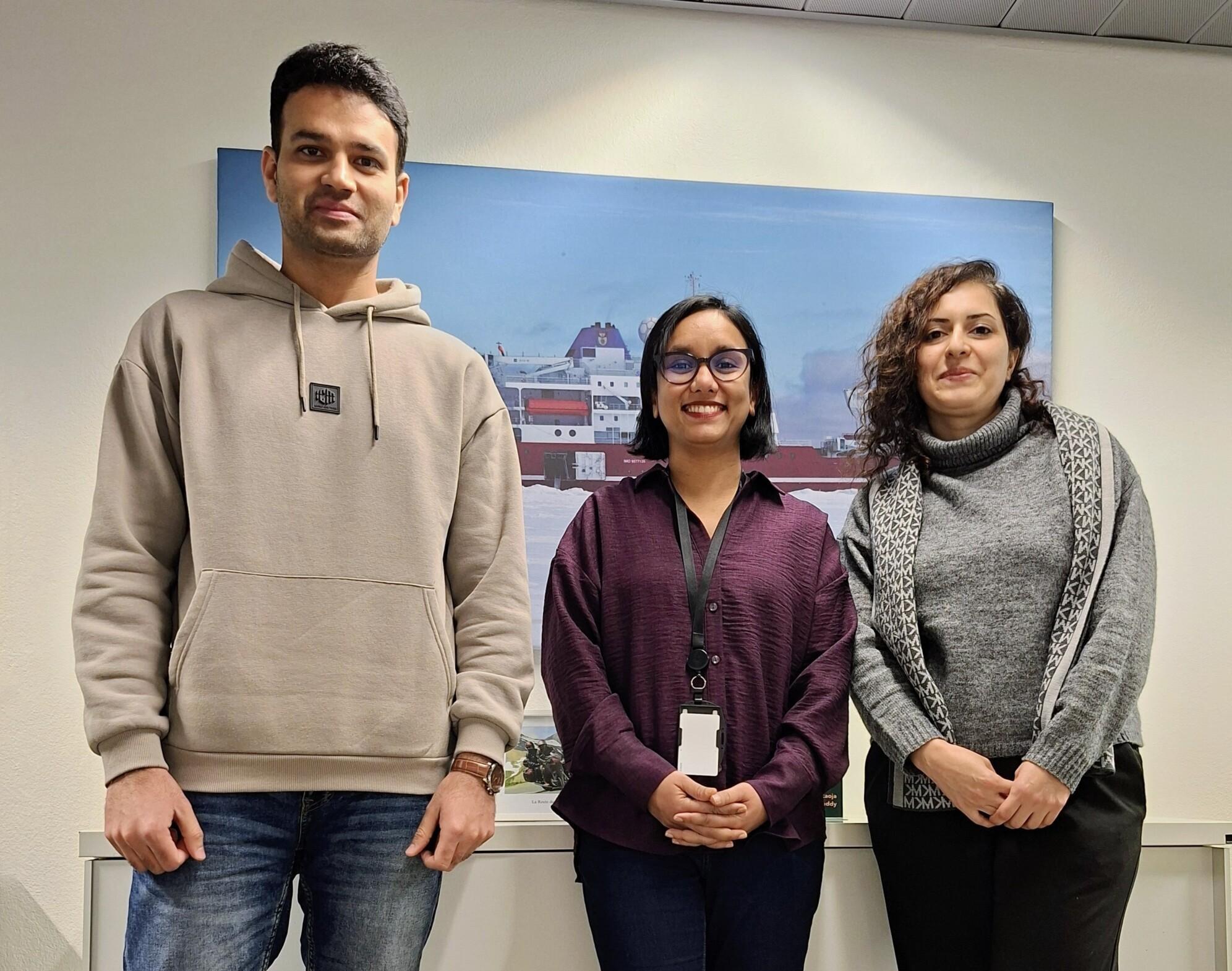
Research Group Spotlight: Intelligence in Marine Systems, Marine and Arctic Technology Research group
In each issue of the WATERWAYS newsletter, we introduce one of the research groups contributing to the project. The short interviews aim to highlight the diverse expertise, research interests, and stakeholder collaborations that shape the work within the project.
Principal Investigator: Mashrura Musharraf
Organization: Department of Energy and Mechanical Engineering, Aalto University
1. Tell about your own research background and expertise.
My background is in computer engineering, with a PhD and M.Eng. from Memorial University of Newfoundland, Canada. My expertise lies at the intersection of computer engineering, marine technology, and human factors, with a focus on applying data mining, machine learning, and AI methods to human-centered digitalization and automation in the maritime domain. I work across the full data lifecycle, eliciting knowledge from subject-matter experts, designing and conducting full-scale simulator experiments, integrating heterogeneous data sources, and developing predictive and diagnostic analytics.
2. What kind of research is being conducted within your research group?
My research group investigates the development of sustainable, human-centered intelligent ships by integrating four interconnected dimensions: technological, human, organizational, and societal. Although each of these dimensions has been studied in isolation, our work is among the first to systematically bring them together.
On the technological side, we advance data-driven methods and AI techniques to support ship automation, autonomy, and intelligent decision-support systems. The human element focuses on ensuring that the choices, values, and operating logic of increasingly complex AI systems remain interpretable and compatible with human operators. This also includes extensive human-in-the-loop testing for any AI-enabled automated functions on board. The organizational dimension examines how roles, competencies, and training requirements for future seafarers evolve as technology becomes more embedded in daily operations. Finally, the societal element addresses regulatory and policy gaps by developing requirements, evaluation criteria, and governance principles needed for sustainable and trustworthy intelligent ships.
3. What research questions and topics is your team focusing on within the WATERWAYS project?
The Baltic Sea’s waterways support a wide range of activities, from shipping and offshore wind construction to fisheries and recreational boating. These sectors share the same maritime space, and each contributes positively to certain UN Sustainable Development Goals (SDGs)—for example by supporting connectivity, clean energy, or local livelihoods. At the same time, some activities can also create pressures that align less well with other SDGs, such as those related to marine ecosystems. As competition for sea space increases, the challenge is to understand how these sectors collectively use the waterways and how their combined effects can be balanced.
In the WATERWAYS project, our team examines how different sectors utilize and depend on the Baltic Sea waterways, using data-driven analysis to build a holistic picture of multi-sectoral activity. By analysing AIS, GIS, and other existing datasets with AI and optimisation techniques, we aim to identify patterns of use, overlaps, and areas where the system could function more efficiently.
Our goal is to support a balanced and sustainable utilization of the waterways, where the positive contributions of different sectors can be strengthened and their negative impacts can be minimised in a coordinated way. Through this work, we hope to contribute to a more coherent understanding of how the Baltic Sea can be used responsibly, effectively, and in a way that benefits society as a whole.
4. What kind of collaboration are you planning with stakeholders as part of this work?
Our work in WATERWAYS depends on close collaboration with a wide range of stakeholders who use, manage, or are affected by the Baltic Sea’s waterways. These include public authorities and policymakers, maritime and environmental agencies, and organisations involved in Maritime Spatial Planning. We will also work with private-sector actors such as port operators, shipping companies, and offshore wind developers, as well as NGOs and civil-society groups representing recreation, cultural heritage, and environmental protection.
These stakeholders help us verify how different sectors currently use the waterways and how these activities connect to broader sustainability goals. Their knowledge is essential for understanding practical needs, identifying where sectors complement or compete with one another, and clarifying the boundaries within which optimisation and modelling should operate.
In return, our team provides insights that support planning and management of waterway use. This includes identifying patterns in navigation routes, highlighting potential bottlenecks, examining sectoral pressures, and exploring ways to improve traffic efficiency, resource use, and environmental protection. Our analytical tools aim to strengthen stakeholders’ ability to evaluate multi-sectoral interactions and to discuss how the Baltic Sea’s waterways can be used in a balanced and sustainable way.
Ultimately, this two-way engagement ensures that our research remains grounded in real-world needs and that its outcomes can be directly applied by the people responsible for shaping the future of the Baltic Sea.